
A Life on the Margins
Eddie Owens Martin was born on July 4, 1908, to sharecroppers in rural southwest Georgia. A child of the red clay and pine scrub of Marion County, he never quite fit in. The conservative, God-fearing culture of the rural South felt suffocating to him, and at fourteen he left, hitchhiking to New York City and stepping onto its streets in the middle of the roaring twenties with little more than nerve.
In New York, Martin supported himself as a hustler, a fortune teller, and a waiter in a gay nightclub. He moved through the city’s underground — among drag queens, drug dealers, artists, and outcasts — and absorbed everything the museums, galleries, public libraries, and streets of Greenwich Village had to offer. Here he found communities where identity was fluid and continually reinvented. Martin was paying attention.
Then, in 1935, during a high fever, everything changed. Martin experienced a vision: a massive, futuristic, gender-fluid being appeared and commanded him to change his ways and follow a new spiritual path called Pasaquoyanism. Martin agreed. He took the name St. EOM, pronounced “ohm,” and became the world’s first Pasaquoyan. He would remain in New York for twenty-one more years, developing his belief system, drawing obsessively, and building a Pasaquoyan aesthetic and cosmology unlike anything that had come before.
A Universe into Being
Some of the drawings in this exhibition offer a window into St. EOM in the act of becoming. These New York drawings are not careful studies or preparatory sketches. They are rapid, urgent notations made in pencil or pen on whatever scrap was at hand. They were created in rented rooms and borrowed spaces between fortune-telling sessions and sex work. Their material modesty is part of their power. Unencumbered by formal training or precious materials, St. EOM used drawing as a direct line to his revelation.
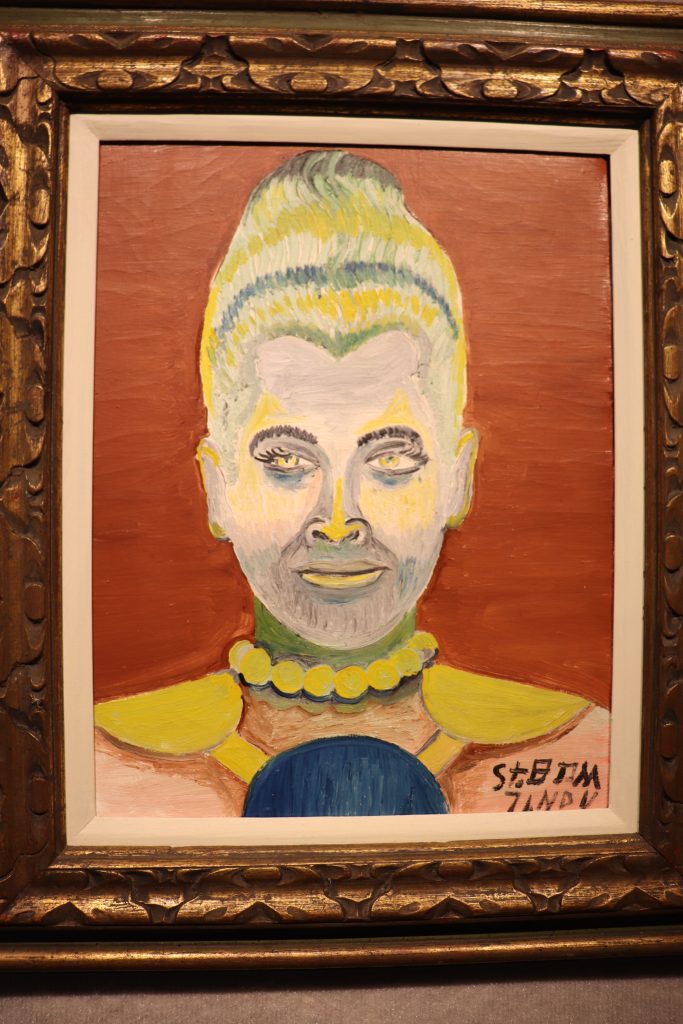
What emerges from these drawings is an entire civilization. Faces stare out with eyes that seem to see through time. Bodies twist, elongate, and multiply, caught in the movements of some unearthly choreography. Headdresses rise to architectural heights. Beards spiral. Features merge and multiply. These are not portraits of individuals but explorations of what humans might become when freed from convention. The Pasaquoyans are gender-fluid beings from a utopian future. Looking at these early drawings alongside the imagery St. EOM later created at Pasaquan, you can trace the origins of the Pasaquoyan aesthetic — the guardian figures, the cosmic dancers, the ceremonial garments — that would eventually be painted on concrete across acres of southwest Georgia farmland.
The Return Home and the Making of Pasaquan
In 1956, the Pasaquoyans returned to St. EOM in a vision and told him to go home to Georgia, to his recently deceased mother’s farm outside Buena Vista. He obeyed. Back in the rural South, he supported himself as a fortune teller and began transforming the family farmstead into Pasaquan, a project that would consume the final three decades of his life.
Across seven acres of Marion County farmland, St. EOM built six structures covered in intricate mandala murals and more than 900 feet of elaborately painted masonry walls. The imagery draws on a wide range of cultural and spiritual sources: pre-Columbian Mexican symbolism, West African and Native American visual traditions, and the “sacred symbols” found in James Churchward’s The Lost Continent of Mu. The result is a site of overwhelming density and conviction. Pasaquan is a place that feels at once ancient and futuristic, built through sustained creative devotion.
The later paintings in this exhibition, most on canvas, carry that same spirit in concentrated form. Working in vivid, high-chromatic color, St. EOM populated his canvases with the same guardian figures and ceremonial beings that watch over Pasaquan. Here the imagery is distilled. The faces are frontal and commanding, radiating an authority that reads as ancient idol and futuristic deity. In many of these paintings, pattern and figure compete for the same space, background and foreground collapse into a single vibrating surface. These works carry his spiritual vision in portable form. They are, in a sense, Pasaquan condensed.
Today, Pasaquan is listed on the National Register of Historic Places and recognized as one of the most significant visionary art environments in the United States. It is stewarded by Columbus State University and the Pasaquan Preservation Society. The works in this exhibition are part of the Columbus State University Archives collection. They span St. EOM’s creative life, from the New York drawings to the paintings rooted in his years at Pasaquan. Together they trace the full arc of that life.
Pasaquan is located 8 miles outside Buena Vista, Georgia, and is open to the public. Columbus State University holds 1,200 works by St. EOM in its permanent collection.